
Finding accurate property information can be an essential and urgent need. Homeowners, real estate professionals, business owners, and concerned residents often seek clear answers during important decisions. In Lorain County, access to GIS records provides transparency, reliability, and reassurance when it matters most.
Whether you are trying to confirm property boundaries, understand zoning regulations, or research land use patterns, reliable geographic information helps remove confusion. Official Lorain County GIS records ensure that people are not left guessing or relying on unverified sources. Having accurate spatial data brings confidence, clarity, and peace of mind during critical moments.
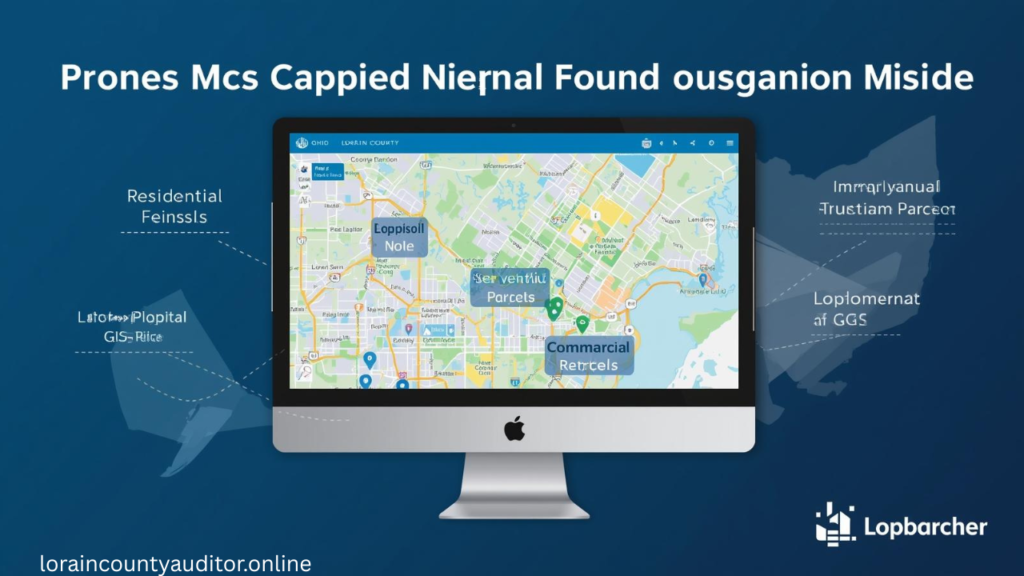
Lorain County GIS: Your Gateway to Geographic Data
Lorain County GIS allows the public to view verified property and geographic information through official county records. These records are maintained to support transparency while respecting legal and privacy boundaries. By using the Lorain County GIS system, users can confirm property details, examine land characteristics, and review location-based information that shapes daily decisions.
The system is designed to provide accurate and timely updates directly from county departments. This helps residents, families, businesses, and professionals access reliable Lorain County GIS information without unnecessary delays or misinformation. The platform combines data from multiple sources including the auditor’s office, planning commission, and engineering department into a unified spatial framework.
Understanding how Lorain County GIS works empowers users to make informed choices about property purchases, development projects, and community planning. The integration of mapping technology with public records creates opportunities that were previously impossible without visiting multiple government offices.
How the Lorain County GIS System Works
The Lorain County GIS system collects data from various county departments and updates it as changes occur. Information is entered by authorized officials and reviewed regularly to ensure accuracy. Users can search using property addresses, owner names, parcel numbers, or by clicking directly on interactive maps.
Because the data comes from official sources, the Lorain County GIS records reflect current property ownership, assessed values, and land characteristics. This helps users avoid outdated or incorrect information that might lead to costly mistakes. The system processes thousands of property records, maintaining consistency across the entire county.
Interactive mapping tools allow users to visualize information in ways that traditional text records cannot provide. Aerial imagery, property boundaries, and various data layers combine to create comprehensive views of land parcels and their surroundings. This visual approach makes complex geographic relationships easier to understand for users of all experience levels.
Regular maintenance and quality control procedures ensure that Lorain County GIS remains a trusted resource. When deed transfers occur, assessment values change, or zoning regulations update, the system captures these modifications to keep information current and relevant.
What Information Lorain County GIS Records Provide
Lorain County GIS records typically include property ownership details, parcel identification numbers, assessed valuations, and tax information. Lot dimensions, building characteristics, sale histories, and zoning classifications also appear in comprehensive property profiles. This structured data helps users understand situations clearly and make informed decisions.
Physical property features documented in Lorain County GIS include building square footage, construction year, number of rooms, and structural details. Aerial photographs provide visual confirmation of property conditions, while legal descriptions establish precise boundaries. Environmental overlays add information about wetlands, floodplains, soil types, and topographic features that influence land use potential.
Infrastructure data reveals utility locations, road classifications, and public service coverage areas. School district boundaries, emergency service jurisdictions, and municipal limits help users understand governmental relationships affecting their properties. Historical records sometimes extend back decades, documenting how properties and neighborhoods evolved over time.
Access to accurate Lorain County GIS information reduces uncertainty and supports confident action, especially for families purchasing homes, businesses selecting locations, or developers planning projects. The depth and breadth of available data addresses questions ranging from simple property lookups to complex spatial analysis.
Why Accurate Lorain County GIS Information Matters
Accuracy in Lorain County GIS records is essential for public trust and effective decision-making. Families rely on correct information to research neighborhoods before purchasing homes, while businesses depend on verified data for site selection and market analysis. Even small errors in property boundaries or zoning classifications can cause significant stress and financial consequences.
Reliable Lorain County GIS data ensures fairness in property transactions, protects individual rights, and strengthens confidence in government transparency. When people trust the information they receive, they engage more actively in community planning processes and civic activities. This participation creates better outcomes for neighborhoods and the county as a whole.
Property professionals including real estate agents, appraisers, surveyors, and title companies build their work on the foundation of accurate geographic data. Construction contractors rely on utility locations and setback requirements from Lorain County GIS to plan projects safely and efficiently. Attorneys reference property records during legal proceedings where precise documentation matters tremendously.
The economic impact of accurate Lorain County GIS extends throughout the community. Proper assessments ensure fair tax distribution, while reliable zoning information guides appropriate development. Environmental protections work effectively when wetland and floodplain data accurately reflects ground conditions. All these benefits trace back to careful data collection and maintenance.
Responsible Use of Lorain County GIS Records
Lorain County GIS records are intended for lawful and ethical use. The county provides public access while following regulations that protect personal rights and privacy. Responsible use means relying on official sources, understanding data limitations, and avoiding misuse of sensitive information for harassment or discrimination.
Property information serves legitimate purposes including research, planning, and informed decision-making. Using Lorain County GIS data appropriately helps maintain the integrity of public records and ensures continued access for those who genuinely need it. Ethical users respect that while property ownership is public information, it should not be weaponized against individuals.
Education about proper interpretation prevents misunderstandings that might arise from technical data. Property boundaries shown on Lorain County GIS maps provide excellent general reference but should not replace professional surveys for legal purposes. Assessment values offer useful benchmarks yet may not precisely match current market conditions. Understanding these distinctions helps users apply information correctly.
Commercial users of Lorain County GIS data should review terms of service regarding permitted uses, attribution requirements, and redistribution limitations. Some jurisdictions restrict bulk downloads or impose conditions on derivative products created from public data. Compliance with these rules supports the sustainability of open data initiatives.
Legal and Public Uses of Lorain County GIS Data
Lorain County GIS data is commonly used for property research, development planning, market analysis, and civic engagement. Real estate professionals rely on these records for pricing strategies and neighborhood comparisons. Urban planners use spatial data to evaluate growth patterns and infrastructure needs. Researchers analyze geographic trends that inform policy decisions.
Legal applications include title searches, boundary disputes, easement verification, and zoning compliance reviews. Attorneys present Lorain County GIS maps as evidence in court proceedings where property relationships require visual demonstration. Environmental consultants reference wetland and floodplain data during permit applications and impact assessments.
Journalists and watchdog organizations access Lorain County GIS for investigative reporting on development proposals, tax assessments, and land use controversies. Academic researchers study urban sprawl, demographic shifts, and economic development using geographic datasets. Emergency management agencies incorporate property data into response plans and evacuation strategies.
Public access supports accountability in government operations while enabling individual empowerment through information. The balance between transparency and privacy remains important, with most jurisdictions carefully considering what information should be publicly available versus protected.
Common Reasons for Searching Lorain County GIS Records
People search Lorain County GIS records for many practical reasons throughout different life stages and business activities. Homebuyers research properties before making purchase offers, examining lot sizes, tax histories, and neighborhood characteristics. Sellers use comparable sales data to establish realistic listing prices that attract qualified buyers.
Homeowners reference Lorain County GIS when planning renovations to verify setback requirements, lot coverage limitations, and zoning restrictions. Fence installations, swimming pools, and additions all benefit from understanding property boundaries and regulatory constraints. Avoiding violations prevents expensive corrections and legal complications.
Investors analyze Lorain County GIS data to identify undervalued properties, development opportunities, and market trends. Demographic information combined with property characteristics helps predict rental demand and appreciation potential. Portfolio management becomes more strategic with comprehensive spatial analysis.
Businesses selecting locations examine Lorain County GIS for customer demographics, traffic patterns, competitor proximity, and zoning allowances. Retail success often depends on visibility and accessibility revealed through geographic analysis. Industrial operations require specific infrastructure confirmed through utility mapping and transportation network evaluation.
Residents concerned about proposed developments use Lorain County GIS to understand project details, verify compliance with regulations, and participate meaningfully in public hearings. Environmental advocates monitor wetland preservation and habitat protection through spatial data. Historical researchers trace community evolution through changing land use patterns.
Lorain County GIS Coverage and System Scope
Lorain County GIS records cover all properties within the county’s geographic boundaries, from dense urban neighborhoods to rural agricultural lands. The system encompasses multiple municipalities, townships, and unincorporated areas, maintaining consistent data standards across jurisdictions. This countywide approach eliminates gaps that might exist in fragmented systems.
Different government departments contribute specialized information to Lorain County GIS, creating a comprehensive resource greater than any single agency could maintain alone. The auditor provides assessment and ownership data, planning departments add zoning and land use information, engineering contributes infrastructure details, and environmental agencies supply ecological overlays.
Integration across departments prevents duplication of effort while ensuring data consistency. When property transfers occur, the deed information recorded by one office automatically updates related systems, maintaining synchronization. This coordination improves efficiency for government operations and accuracy for public users.
Lorain County GIS extends beyond simple property boundaries to include transportation networks, hydrologic features, political jurisdictions, and service areas. Regional planning initiatives sometimes incorporate data from neighboring counties, creating broader geographic context for understanding regional trends and relationships.
Accessing Property Records Through Lorain County GIS
Property information retrieval through Lorain County GIS begins with navigating to the county’s online portal where interactive maps and search tools await. The interface accommodates various skill levels, from first-time users seeking basic information to experienced professionals conducting complex analysis. Multiple search options ensure that users can find properties regardless of what information they initially possess.
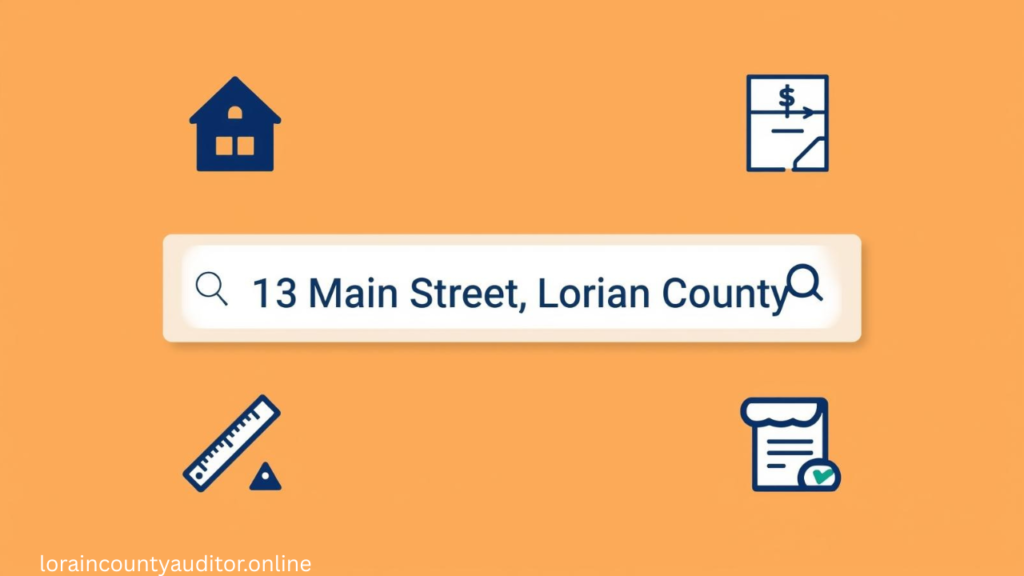
Address searches work well when users know the location they want to research. Simply typing a street address into the search bar typically locates the corresponding parcel within seconds. The system usually forgives minor spelling variations and incomplete information, though precise entries yield faster results.
Owner name searches help when addresses remain unknown but ownership information is available. This functionality proves valuable when researching properties held by specific individuals, families, or companies. Businesses tracking their real estate portfolios appreciate the ability to retrieve all properties under a particular ownership entity.
Parcel identification numbers provide the most precise search method when these unique identifiers are known from other documents like tax bills or legal notices. Each property receives a permanent parcel number that remains constant even when ownership transfers, providing a reliable reference across different information systems.
Interactive map searching allows users to explore visually by zooming to neighborhoods of interest and clicking directly on properties. This geographic approach works naturally for users familiar with an area but uncertain of exact addresses. Visual exploration sometimes reveals unexpected information or sparks questions that structured searches would not uncover.
Understanding Property Details in Lorain County GIS
Once a property is located, Lorain County GIS displays comprehensive details organized into logical categories. Ownership information typically appears prominently, showing current owners, mailing addresses, and ownership percentages for properties with multiple parties. Transfer dates indicate how recently the property changed hands, while deed references connect to recorded legal documents.
Assessment data breaks down property value into land and building components, showing how each contributes to the total taxable value. Historical assessment trends reveal whether values have risen, fallen, or remained stable over recent years. This context helps users understand whether current assessments align with market movements.
Physical characteristics document building features including square footage, room counts, stories, basement status, garage capacity, and construction materials. Exterior walls, roof types, heating systems, and interior finishes all receive notation in detailed property records. Outbuildings, pools, and other improvements appear separately with their own descriptions and valuations.
Lot dimensions specify property depth, width, and total acreage, while legal descriptions provide precise boundary definitions using surveying terminology. Topographic information indicates whether properties sit on slopes, flat ground, or irregular terrain. These physical details matter tremendously for development potential and construction planning.
Zoning classifications determine permitted uses and development intensity. Residential zones vary from single-family to multi-unit designations, while commercial and industrial zones accommodate different business types. Overlay districts sometimes add special requirements in historic areas, scenic corridors, or environmental protection zones.
Navigating the County Auditor’s Tax Records
The auditor’s section of Lorain County GIS focuses specifically on taxation and financial aspects of property ownership. Tax payment histories reveal whether current obligations are satisfied or delinquencies exist that might complicate transactions. Special assessments for infrastructure improvements appear as line items showing amounts and payment schedules.
Millage rates determine how assessed values convert to actual tax bills, with different rates applying for schools, municipalities, libraries, parks, and other taxing authorities. Understanding the breakdown helps property owners see exactly where their tax dollars flow and predict future obligations under various scenarios.
Homestead exemptions reduce tax burdens for qualifying primary residences, with Lorain County GIS indicating which properties receive these benefits. Senior citizen credits, disabled veteran exemptions, and agricultural use valuations also appear in tax records, documenting various relief programs that influence final tax amounts.
Tax districts define which governmental jurisdictions collect taxes from specific properties. School district boundaries often generate the most interest since they significantly impact property values and determine which institutions children attend. Multiple overlapping districts create complex but important relationships that Lorain County GIS helps clarify visually.
Delinquent tax information serves as public notice that obligations remain unsatisfied, potentially indicating financial distress or contested assessments. Investors sometimes seek properties with tax issues, anticipating negotiation opportunities or eventual tax sales. However, purchasing property with delinquent taxes requires careful legal review to understand liabilities.
Planning and Zoning Information in Lorain County GIS
Land use regulations accessible through Lorain County GIS shape community character and govern development across different areas. Comprehensive plans articulate long-term visions that guide individual zoning decisions and infrastructure investments. These policy documents provide context for understanding why certain locations permit intensive development while others maintain rural character.
Zoning maps integrated into Lorain County GIS divide the county into districts with specific permitted uses and dimensional standards. Residential zones range from low-density single-family neighborhoods to high-density apartment districts, each with different building height limits, setback requirements, and lot coverage allowances.
Commercial classifications accommodate neighborhood retail, office complexes, regional shopping centers, and highway-oriented development. Performance standards regulate signage, parking, landscaping, and architectural features to maintain visual quality. Mixed-use zones encourage combinations of residential and commercial activities in walkable environments.
Industrial designations distinguish light manufacturing compatible with other uses from heavy industry requiring separation and buffering. Environmental performance standards limit noise, vibrations, odors, and emissions that might affect surrounding properties. Access to transportation infrastructure often determines industrial zoning patterns.
Special districts overlay additional regulations in areas warranting extra protection or development guidance. Historic preservation zones maintain architectural character through design review. Floodplain overlay districts restrict development in areas prone to inundation. Gateway corridors emphasize aesthetic standards along major roadways entering communities.
Environmental Data Layers in Lorain County GIS
Ecological information integrated into Lorain County GIS supports environmental protection and natural resource management. Wetland inventories identify regulated areas where development faces restrictions under state and federal clean water laws. Different wetland types—emergent marshes, forested swamps, vernal pools—provide distinct ecological values and face varying regulatory frameworks.
Floodplain mapping delineates areas subject to periodic inundation during storms of different intensities. The 100-year floodplain represents areas with 1% annual flood probability, triggering mandatory insurance requirements and elevation standards for new construction. Floodway designations identify zones where development would increase flood heights on other properties, facing even stricter prohibitions.
Soil surveys classify earth materials by drainage characteristics, bearing capacity, agricultural productivity, and septic system suitability. Lorain County GIS often incorporates detailed soil maps showing how subsurface conditions vary across landscapes. Well-drained soils support diverse development while poorly-drained areas require special engineering or face use limitations.
Stream corridors and watershed boundaries visible in Lorain County GIS show how water flows across terrain, connecting upstream activities to downstream water quality. Riparian buffers protect aquatic habitat and filter pollutants, often facing development restrictions to preserve ecological functions. Understanding drainage patterns prevents flooding problems and protects environmental resources.
Topographic data reveals elevation changes, slopes, and terrain features influencing development costs and land use suitability. Steep slopes increase construction expenses and erosion risks while flat areas simplify building. Three-dimensional terrain visualization helps users understand landforms that two-dimensional maps cannot fully convey.
Infrastructure and Utility Mapping Features
Transportation networks form critical frameworks shown in Lorain County GIS supporting mobility and development patterns. Road classifications distinguish local streets serving individual properties from collectors channeling traffic to major routes and arterials moving high volumes across longer distances. Functional classifications determine maintenance responsibilities and design standards.
Utility infrastructure locations prevent costly conflicts during excavation and guide service extension planning. Water mains, sanitary sewers, storm drains, gas lines, electric cables, and telecommunications networks occupy subsurface spaces requiring careful coordination. Lorain County GIS helps contractors and developers identify existing utilities before breaking ground on projects.
Public transit routes and facilities appear on some Lorain County GIS platforms, helping residents access transportation options beyond private vehicles. Bus stops, park-and-ride lots, and future expansion plans support mobility planning. Bicycle infrastructure including trails, lanes, and shared roadways encourages active transportation with gap analysis identifying missing connections.
Emergency service coverage areas displayed in Lorain County GIS show response jurisdictions for fire departments, police agencies, and ambulance providers. Adequate coverage ensures rapid response during emergencies, while gaps might indicate areas needing additional stations or mutual aid agreements. Siren locations for severe weather warnings contribute to public safety planning.
Educational Boundaries and School Information
School attendance zones accessible through Lorain County GIS determine which institutions serve specific addresses, profoundly influencing property values and family location decisions. Elementary, middle, and high school boundaries often differ, creating geographic complexity for families with children at multiple grade levels. Understanding these zones helps families plan housing choices around educational preferences.
District boundaries separate communities served by different school systems, each with distinct tax rates, educational philosophies, and performance metrics. Families researching relocation options compare standardized test scores, graduation rates, and program offerings across neighboring districts visible in Lorain County GIS. Property values often reflect perceived school quality, creating premiums in highly-rated districts.
Private and charter school locations supplement public options shown in Lorain County GIS, offering alternative educational approaches. While these institutions typically lack geographic enrollment boundaries, proximity still influences accessibility and transportation convenience. Comprehensive educational mapping helps families understand all available options.
Future school construction sites and boundary proposals appear in long-range facilities plans sometimes linked through Lorain County GIS. Growing areas might require new schools while stabilizing regions consolidate facilities. Proposed boundary adjustments redistribute students and potentially affect property values when neighborhood school assignments change.
Real Estate Market Analysis Using Lorain County GIS
Property sale comparables accessible through Lorain County GIS form the foundation of real estate valuation. Recent transactions for similar properties in comparable locations establish market value benchmarks. Geographic proximity, property characteristics, and sale timing all factor into comparative market analysis that buyers and sellers use for pricing decisions.
Market trend analysis examines sale prices over time to identify appreciation or depreciation patterns. Heat maps visualizing price changes across Lorain County reveal which neighborhoods experience rapid growth versus stable or declining markets. Inventory levels comparing active listings to closed sales indicate whether markets favor buyers or sellers.
Investment property analysis combines rental rate data with operating expenses and acquisition costs revealed through Lorain County GIS. Cap rates, cash flow projections, and return calculations guide purchase decisions for income-producing properties. Demographic overlays showing population density and household incomes help identify underserved markets or emerging opportunities.
Development feasibility studies integrate land costs, zoning allowances, and infrastructure availability from Lorain County GIS. Pro forma financial models project construction expenses, financing costs, and revenue potential across different development scenarios. Site selection weighs multiple factors—accessibility, visibility, demographics, competition—to identify optimal locations for specific uses.
Agricultural Land and Rural Property Research
Farmland valuations documented in Lorain County GIS apply special methodologies recognizing agricultural use rather than development potential. Current Agricultural Use Value programs reduce tax burdens for working farms, preserving rural land uses against development pressure. Qualification requirements verify active farming through income thresholds and production documentation.
Soil productivity ratings classify agricultural lands by crop yield potential and management requirements. Prime farmlands offer superior capabilities commanding premiums when farmers expand operations. Lorain County GIS helps identify high-quality agricultural soils versus marginal lands requiring intensive management or facing significant limitations.
Drainage districts maintain collective infrastructure removing excess water from agricultural areas. Assessment obligations fund ditch maintenance and tile repairs benefiting all parcels within district boundaries. Understanding these ongoing costs through Lorain County GIS helps prospective buyers budget accurately for farmland ownership.
Conservation easements permanently restrict development on agricultural and natural lands, preserving open space in exchange for tax benefits. These legal encumbrances run with property titles, binding future owners to agricultural or conservation uses. Reviewing easement information in Lorain County GIS prevents misunderstandings about development potential.
Historical Records and Archive Features
Historical layers in Lorain County GIS sometimes include archived maps documenting original subdivisions and ownership patterns that shaped community development. Comparing historical plats with current conditions reveals how properties divided over time and how neighborhoods evolved. This temporal perspective enriches understanding of present-day conditions.
Aerial photograph archives create visual records showing landscape changes over decades. Sequential imagery from different years reveals urban expansion consuming farmland, forests regrowing on abandoned fields, and waterways changing courses. Historical ecology studies use these records to understand pre-development conditions informing restoration projects.
Building age data helps identify structures potentially eligible for historic preservation programs. Architectural styles and construction methods characteristic of different eras create tangible connections to community heritage. Demolition permits and replacement construction documented over time show turnover in building stock affecting neighborhood character.
Property ownership genealogies trace how land passed through families and changed hands during economic transitions. Local historians and genealogical researchers use Lorain County GIS alongside other records to reconstruct past communities and understand settlement patterns. These historical applications demonstrate how geographic data serves purposes beyond current property transactions.
Understanding Assessment Procedures and Valuations
Triennial reappraisals update property values in Lorain County GIS reflecting market conditions and physical changes. Mass appraisal techniques process thousands of properties simultaneously using sales data, cost schedules, and statistical models. Individual inspections verify building characteristics and identify improvements requiring assessment adjustments.
Assessment challenges allow property owners to contest valuations they believe exceed fair market value. Informal review processes provide opportunities to present evidence before formal appeals. Comparative market analyses, independent appraisals, and documentation of property defects support arguments for reduced assessments that might appear subsequently in Lorain County GIS.
Tax rates convert assessed values into actual obligations through millage applied by various taxing authorities. School districts typically claim the largest share, with municipalities, counties, and special districts dividing the remainder. Voted levies for specific purposes add temporary or permanent increases that Lorain County GIS helps users understand through historical rate data.
Payment options and delinquency consequences appear in tax records accessible through Lorain County GIS. Senior deferrals, disabled veteran exemptions, and homestead credits reduce burdens for qualifying owners. Understanding available relief programs helps property owners minimize tax obligations legally and ethically.
Advanced Search Techniques in Lorain County GIS
Power users of Lorain County GIS employ advanced search strategies to find properties matching specific criteria. Boolean operators combine multiple conditions creating precise queries that isolate desired property types. Searching for residential properties within certain value ranges near specific amenities demonstrates how complex filters generate targeted results.
Spatial selection tools allow users to draw boundaries on maps and retrieve all properties within designated areas. Radius searches find properties within specific distances from points of interest. Polygon selection captures properties in irregular areas following natural or political boundaries. These geometric queries support sophisticated spatial analysis.
Saved searches preserve complex criteria for future reuse, streamlining repeated research tasks. Professional users monitoring specific property types or tracking market segments benefit from quickly reactivating predefined queries. Export functions generate spreadsheets or databases enabling further analysis in specialized software beyond basic Lorain County GIS functionality.
Custom map compositions combine selected data layers with specific styling and labeling to create professional presentations. Users can adjust colors, symbols, and transparency to highlight particular features or relationships. Print layouts incorporate legends, scale bars, and title blocks producing publication-ready graphics from Lorain County GIS data.
Data Quality and Accuracy Considerations
Information displayed in Lorain County GIS reflects source data quality from various systems including deeds, surveys, and field inventories. Occasional errors arise from transcription mistakes, outdated records, or conflicting documentation. Users making critical decisions should verify important details through official record searches or professional services rather than relying solely on mapped information.
Property boundaries shown provide excellent general reference but lack the precision of professional surveys conducted by licensed practitioners. Fence locations and physical features may not align perfectly with legal descriptions. Boundary disputes require survey evidence and potentially legal proceedings to establish definitive property lines beyond what Lorain County GIS depicts.
Assessment records reflect conditions at specific dates and may not capture very recent changes. Building permits issued after assessment cycles, demolitions, or improvements might not yet appear in property characteristics. Sale prices represent historical market conditions that could differ substantially from current values in rapidly changing markets.
Database update frequencies vary across information layers within Lorain County GIS. Some data refreshes continuously while other layers update quarterly, annually, or irregularly. Understanding update schedules helps users evaluate whether displayed information meets currency requirements or needs supplementation from authoritative sources.
Mobile Access and Field Applications
Mobile-responsive versions of Lorain County GIS enable field access through smartphones and tablets. Real estate agents show property information to clients during site visits, while contractors verify utility locations before excavation. Location services automatically center maps on current positions, helping users identify properties while standing on-site without knowing precise addresses.
Offline functionality remains limited on most Lorain County GIS platforms, requiring active internet connections for full features. Users should download critical information before traveling to areas with poor cellular coverage. Screenshots and PDF exports provide alternatives when connectivity cannot be guaranteed.
Mobile applications sometimes offer simplified interfaces prioritizing essential functions over comprehensive features available on desktop versions. Touch-optimized controls replace mouse-driven interactions, while reduced screen sizes require careful interface design. Despite limitations, mobile access extends Lorain County GIS utility beyond office environments into practical field applications.
Future Technology Developments
Three-dimensional visualization tools may eventually enhance Lorain County GIS with vertical dimensions showing building heights and terrain relief. Virtual reality applications could allow immersive property exploration before physical visits. Augmented reality might overlay property boundaries and utility locations onto real-world camera views through smartphone screens.
Artificial intelligence integration could provide natural language query interfaces where users ask conversational questions rather than learning technical search procedures. Predictive analytics might identify properties matching preferences based on behavioral patterns. Machine learning algorithms could generate automated valuations using historical sales data and property characteristics.
Open data initiatives expand public access while encouraging third-party application development leveraging Lorain County GIS information. Standardized formats and programming interfaces allow developers to build specialized tools serving niche markets. Public-private partnerships might enhance capabilities beyond what government budgets alone support.
Conclusion
Access to Lorain County GIS records provides clarity and confidence during important property decisions. Transparent and accurate geographic information helps families find suitable homes, supports business location strategies, and strengthens community planning. Knowing how to access and interpret Lorain County GIS data empowers users with knowledge and understanding.
Responsible use of these records ensures that the system remains fair, reliable, and beneficial for the entire community. As technology advances and data expands, Lorain County GIS will continue serving as an essential resource connecting people with the geographic information they need.
Frequently Asked Questions (FAQs)
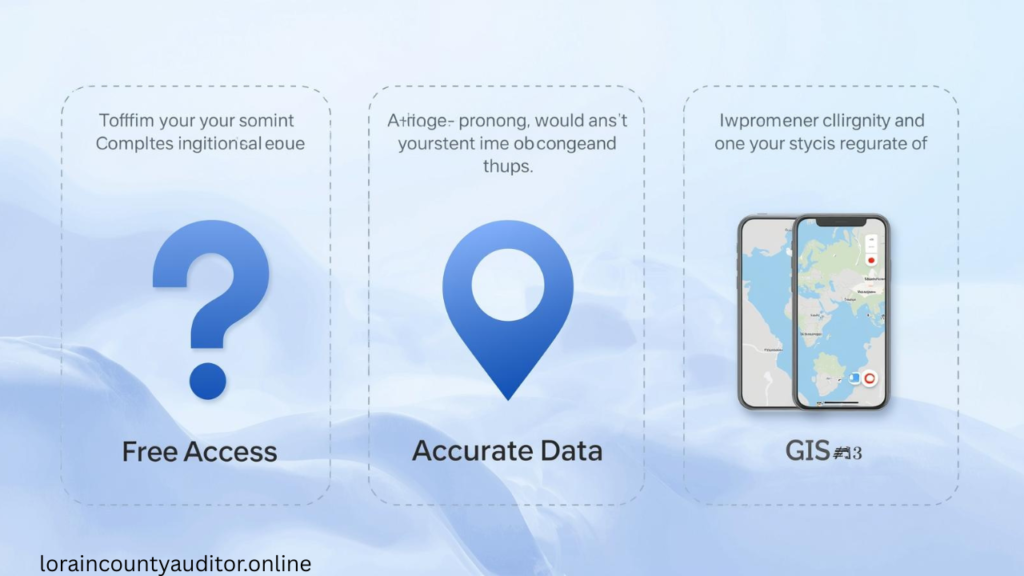
How can I search for property information in Lorain County GIS?
You can search for properties through the official Lorain County GIS portal using street addresses, owner names, or parcel numbers. The interactive map also allows direct clicks on properties for instant information access.
Is the Lorain County GIS free to use?
Yes, basic access to Lorain County GIS is completely free for the public. Standard property searches, map viewing, and basic reports require no registration fees or subscription costs.
What details are shown in Lorain County GIS property records?
Lorain County GIS records display owner names, assessed values, tax histories, lot dimensions, building characteristics, zoning classifications, and sale prices. Aerial photographs and legal descriptions are also typically included.
How often is Lorain County GIS information updated?
Update frequencies vary by data type. Property ownership typically updates within days or weeks, assessment values refresh annually, and aerial photography updates every few years depending on county schedules.
Can I find zoning information through Lorain County GIS?
Yes, Lorain County GIS includes zoning classifications showing whether properties are residential, commercial, industrial, or agricultural. Basic zoning codes and descriptions appear directly on property pages or map layers.
Are the property boundaries shown in Lorain County GIS legally accurate?
Property boundaries provide excellent general reference but should not replace professional surveys for legal purposes. For construction projects or boundary disputes, hiring a licensed surveyor ensures survey-grade precision.
What should I do if information in Lorain County GIS appears incorrect?
Contact the county auditor’s office for ownership or assessment errors, or the planning department for zoning issues. Document specific inaccuracies with parcel numbers and supporting evidence when reporting errors.
Can I download or print maps from Lorain County GIS?
Most Lorain County GIS platforms include printing and export tools for creating customized maps. You can adjust map extent, select data layers, and output high-resolution PDFs for personal use.
How can I use Lorain County GIS for real estate research?
Lorain County GIS provides sales histories, assessment trends, neighborhood data, and comparative market information. You can identify similar sold properties, examine price trends, and evaluate area characteristics for informed decisions.
What mobile options exist for accessing Lorain County GIS?
Many implementations offer mobile-responsive websites or dedicated apps optimized for smartphones and tablets. Location services can automatically center maps on your current position for convenient field use.
Are there any costs associated with using Lorain County GIS?
Basic public access is free for standard property research and viewing. Advanced features like bulk downloads or premium tools designed for commercial use might require paid subscriptions.
Can I find historical property information in Lorain County GIS?
Yes, many systems maintain historical records showing previous owners, past sales, and assessment changes over years or decades. Historical aerial photographs may also reveal how properties changed over time.