
Finding reliable property information can feel like searching for answers in the dark, especially when making important financial decisions or researching real estate investments. Tax maps serve as essential guides that reveal property boundaries, ownership details, and assessment information that directly affect your financial obligations and property rights. In Lorain County, the auditor tax map system provides transparent access to critical data that homeowners, buyers, and professionals depend on daily.
Whether you’re verifying your property lines before building a fence, researching a potential home purchase, or appealing what seems like an unfair assessment, having accurate information brings confidence during uncertain moments. The Lorain County auditor tax map offers more than just lines on paper—it represents legal boundaries, financial obligations, and ownership rights that shape communities. Understanding how to read these tax maps, where to access them, and what information they contain can transform confusion into clarity.
Mistakes in property research can cost thousands of dollars and create legal complications that take years to resolve. The auditor tax map serves as your first defense against errors, providing official records that protect your interests and ensure you’re making decisions based on facts, not assumptions or outdated information.
Understanding the Lorain County Auditor Tax Map System
The Lorain County auditor tax map system functions as the official geographic record of property boundaries, parcel identifications, and ownership patterns across the entire county. These tax maps, maintained by the County Auditor’s office, serve multiple essential purposes from assessment to legal documentation. The auditor tax map integrates information from deed records, surveys, and subdivisions into a comprehensive visual framework that anyone can access and understand.
Every property in Lorain County appears on the auditor tax map with a unique parcel identification number that connects the physical land to ownership records, financial obligations, and legal descriptions. This systematic approach ensures consistency across thousands of properties while allowing detailed tracking of individual parcels. The Lorain County auditor tax map serves as the authoritative source when questions arise about property locations, boundaries, or relationships between neighboring parcels.
Understanding the Lorain County auditor tax map system empowers property owners to verify information independently rather than relying solely on third-party sources that may contain errors. The tax maps provide visual confirmation of what legal descriptions express in technical surveying language, making complex boundary information accessible to people without specialized training. When disputes arise or questions emerge about property characteristics, the auditor tax map offers an official reference point that carries legal weight and community trust.
How the Lorain County Auditor Tax Map Works
The Lorain County auditor tax map operates through a coordinated system linking geographic information to property records maintained by various county departments. When property transfers occur, subdivisions are recorded, or boundaries change through legal processes, these modifications update in the auditor tax map database to reflect current conditions. The system maintains historical records while displaying current ownership and boundary information.
Map scales on the Lorain County auditor tax map vary depending on the area’s development density, with urban neighborhoods shown at larger scales for detail and rural areas at smaller scales to cover more territory. Each tax map sheet covers a specific geographic area, with adjacent sheets connecting to provide complete county coverage. The auditor tax map uses standardized symbology to indicate property lines, easements, rights-of-way, and other features that affect property use and value.
Parcel numbering systems employed in the Lorain County auditor tax map follow logical patterns that often incorporate township, range, section, and sequential identifiers. These numbers remain constant even when property ownership changes, providing stable references that persist across decades. Understanding how to decode parcel numbers helps users navigate the auditor tax map system efficiently and locate specific properties quickly.
Digital versions of the Lorain County auditor tax map have transformed accessibility, allowing users to search, zoom, measure, and print from anywhere with internet access. Interactive features enable property identification through addresses, owner names, or clicking directly on map areas. These technological advances make the auditor tax map more useful than ever while maintaining the accuracy and official status of traditional paper maps.
What Information the Lorain County Auditor Tax Map Provides
The Lorain County auditor tax map displays property boundaries as the primary visual element, showing how parcels divide the landscape and relate to streets, waterways, and other geographic features. Boundary lines indicate legal property limits, though users should recognize that mapped boundaries provide general reference rather than survey-grade precision for legal purposes.
Parcel identification numbers appear on every property shown on the Lorain County auditor tax map, serving as unique identifiers that connect to detailed property records. These numbers link mapped parcels to ownership information, assessed values, payment histories, and legal descriptions maintained in the auditor’s database. Simply knowing a parcel number allows access to comprehensive property information across multiple county systems.
Dimensions and acreage notations on the Lorain County auditor map provide size information for individual parcels. Lot frontages, depths, and total land areas help users understand property scale and verify that mapped boundaries align with deed descriptions. While these measurements offer useful reference, professional surveys provide definitive dimensions for legal purposes.
Street names, block numbers, and subdivision identifications on the Lorain County auditor map help orient users and locate properties within familiar geographic contexts. The maps show how properties relate to surrounding development, nearby amenities, and transportation networks. This contextual information supports property research beyond basic boundary and ownership data.
Easements, rights-of-way, and other encumbrances sometimes appear on the Lorain County auditor map when they affect significant areas or property access. Utility easements, access corridors, and public rights-of-way influence property use and development potential. While maps show major encumbrances, title searches reveal complete encumbrance details that might not appear on these maps.
Accessing the Lorain County Auditor Tax Map
Online access to the Lorain County auditor tax map provides convenient property research from home, office, or mobile devices. The County Auditor’s website hosts interactive mapping tools where users search by address, owner name, parcel number, or geographic location. These digital platforms offer zooming, panning, and layer controls that enhance the traditional paper map experience.
Search functionality on the Lorain County auditor tax map portal accepts various inputs to accommodate different user knowledge levels. Address searches work well when street locations are known, while owner name searches help when researching properties by person or company. Parcel number searches provide direct access when these identifiers appear on bills or legal documents.
The interactive map interface for the Lorain County auditor map allows users to click directly on properties to reveal parcel information. This geographic approach works naturally for people familiar with areas but uncertain of exact addresses. Visual exploration sometimes uncovers unexpected insights or raises questions that structured searches wouldn’t reveal.
Print options for the Lorain County auditor map enable users to create hard copies for field reference, presentations, or record keeping. Customizable print layouts include map scales, legends, and property details that support various uses. Digital exports in PDF format preserve map information for sharing or archiving.
In-person access at the County Auditor’s office provides assistance from staff familiar with the Lorain County auditor map system. When complex research requires expert guidance or questions arise about map interpretation, personal consultation ensures accurate understanding. Staff can explain map features, locate difficult-to-find properties, and suggest research strategies for challenging situations.
Reading and Interpreting Map Features
Property boundary lines on the Lorain County auditor map appear as solid lines separating individual parcels from neighbors and streets. These boundaries derive from recorded plats, deeds, and surveys that legally define property limits. Understanding that mapped boundaries show general locations rather than precise survey coordinates prevents over-reliance on map accuracy for legal purposes.
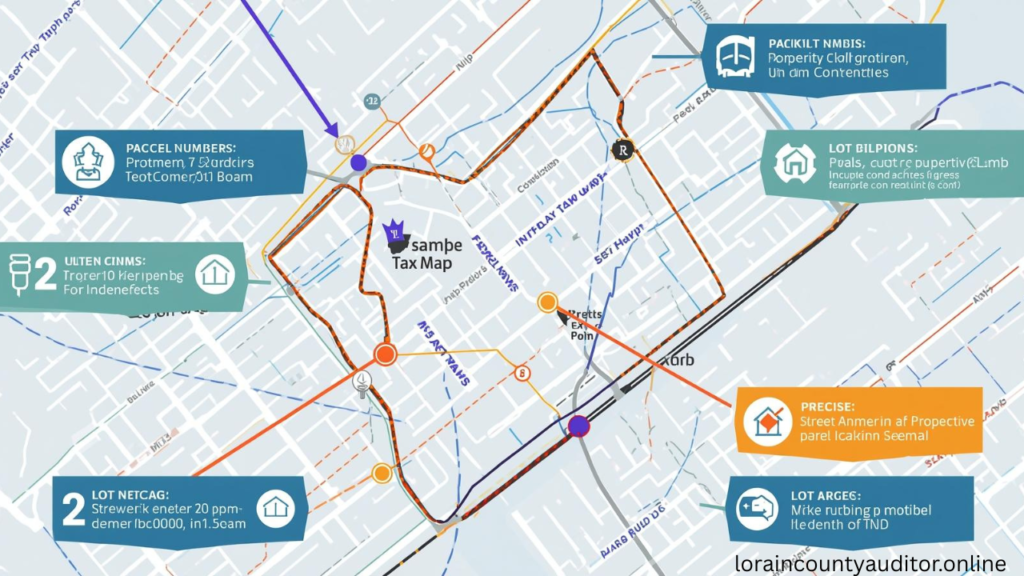
Parcel numbers positioned within property boundaries on the Lorain County auditor map serve as unique identifiers connecting mapped land to detailed records. The number format often reveals geographic hierarchy through township, section, and sequence codes. Decoding these numbers helps users understand property locations within the county’s organizational system.
Dimension notations along property lines on the Lorain County auditor map indicate boundary lengths in feet. Corner angles sometimes appear where boundaries change direction. These measurements help verify lot sizes and shapes match deed descriptions, though professional surveys provide legally defensible precision.
Street dedications and rights-of-way shown on the Lorain County auditor map represent public areas for transportation and utilities. Understanding the distinction between privately owned property and public rights-of-way prevents assumptions that all land within visible boundaries belongs to the property owner. Roads, sidewalks, and utility corridors occupy space that affects usable land area.
Subdivision names and block numbers on the Lorain County auditor map organize properties into development groups. These identifiers help locate properties within larger platted areas and connect to recorded subdivision documents. Historical subdivision information sometimes appears, showing how land divided over time.
Water features, railroad corridors, and other geographic elements on the Lorain County auditor map provide context for property locations. Parcels adjacent to lakes, rivers, or streams face special regulations and opportunities. Understanding geographic relationships helps assess property characteristics and potential constraints.
Common Uses of the Lorain County Auditor Map
Property research before purchase represents one of the most common uses for the Lorain County auditor map, as buyers verify lot sizes, boundary locations, and adjacent land uses. Comparing mapped information to property descriptions in listings reveals discrepancies requiring investigation. The map provides independent verification that protects buyers from misleading information.
Boundary verification for construction projects relies on the Lorain County auditor map to show approximate property lines before installing fences, sheds, or other improvements near boundaries. While the map provides general guidance, property owners should obtain professional surveys before permanent construction to avoid encroachment disputes. The map helps identify when survey investment is necessary.
Assessment research uses the Lorain County auditor map to locate comparable properties for appeal evidence. Finding recently sold parcels similar in size and location supports arguments that assessments exceed fair market value. The visual layout on the map reveals neighborhood patterns that influence property values.
Title research and legal documentation reference the Lorain County auditor map to verify property descriptions and identify potential conflicts. Attorneys use these maps during closings, boundary disputes, and estate settlements. The official status of auditor maps provides credible evidence in legal proceedings.
Development planning requires the Lorain County auditor map to analyze potential sites, assemble parcels, and understand surrounding land uses. Developers examine ownership patterns to identify acquisition opportunities or potential obstacles. The map reveals which parcels might combine for larger projects.
Real estate investment analysis employs the Lorain County auditor map to research neighborhoods, identify undervalued properties, and track market trends. Investors examine assessment patterns, property sizes, and ownership changes visible through map data. Geographic analysis supports strategic decision-making about where to invest limited capital.
Genealogy and historical research utilizes old editions of the Lorain County auditor map to trace property ownership through family generations. Historical maps show how land divided, neighborhoods developed, and ownership patterns evolved. These records connect current properties to historical contexts and family histories.
Connecting Maps to Property Records
The Lorain County auditor map links directly to detailed property records through parcel identification numbers that appear on both maps and database entries. Clicking a parcel on digital maps typically opens property details including ownership, assessed values, payment histories, and physical characteristics. This integration creates seamless research workflows.
Ownership information connected to the Lorain County auditor map includes current owner names, mailing addresses, and acquisition dates. Understanding who owns adjacent properties helps in boundary discussions or when neighboring land use becomes relevant. Ownership data updated regularly reflects recent transfers and changes.
Assessment values accessible through the Lorain County auditor map show how the county values land and improvements for taxation purposes. Separate land and building valuations reveal how each component contributes to total assessed value. Historical assessment trends visible in connected records show whether values are rising, falling, or stable.
Payment status linked to the Lorain County auditor map reveals whether properties carry current obligations or delinquencies. This information matters when researching potential purchases or understanding neighborhood stability. Delinquent payments sometimes indicate financial distress or contested assessments.
Legal descriptions available through the Lorain County auditor map provide technical boundary definitions using surveying terminology. While maps show visual representations, legal descriptions offer precise language defining property limits. Both sources together provide complete boundary documentation.
Building characteristics connected to the Lorain County auditor map include square footage, construction year, room counts, and structural details that affect assessments. This data helps verify that mapped parcels match physical improvements. Discrepancies between mapped parcels and building records sometimes reveal errors requiring correction.
Sales history accessible through the Lorain County auditor map shows when properties last sold and at what prices. This transaction data supports market analysis and valuation research. Tracking sales patterns across neighborhoods reveals appreciation trends and market dynamics.
Understanding Map Scales and Measurements
Map scales on the Lorain County auditor map determine how much real-world distance each map unit represents. Common scales like 1 inch = 100 feet or 1 inch = 200 feet appear on map legends and affect how much detail maps show. Larger scales provide more detail for dense urban areas while smaller scales cover extensive rural territories.
Measurement tools available on digital versions of the Lorain County auditor map allow users to calculate distances and areas directly on screen. These tools help verify lot sizes, measure frontages, or estimate distances to boundaries. Understanding that electronic measurements approximate actual distances prevents over-reliance on screen calculations for precise legal purposes.
Acreage calculations on the Lorain County auditor map convert square footage to acres for easier comprehension of large parcel sizes. Standard conversion ratios (43,560 square feet per acre) ensure consistency. Comparing mapped acreage to deed acreage helps identify discrepancies requiring investigation.
Frontage dimensions shown on the Lorain County auditor map indicate property width along streets or other boundaries. Frontage measurements matter for zoning compliance, assessment calculations, and development potential. Verifying frontage accuracy protects against errors that might affect property value or use.
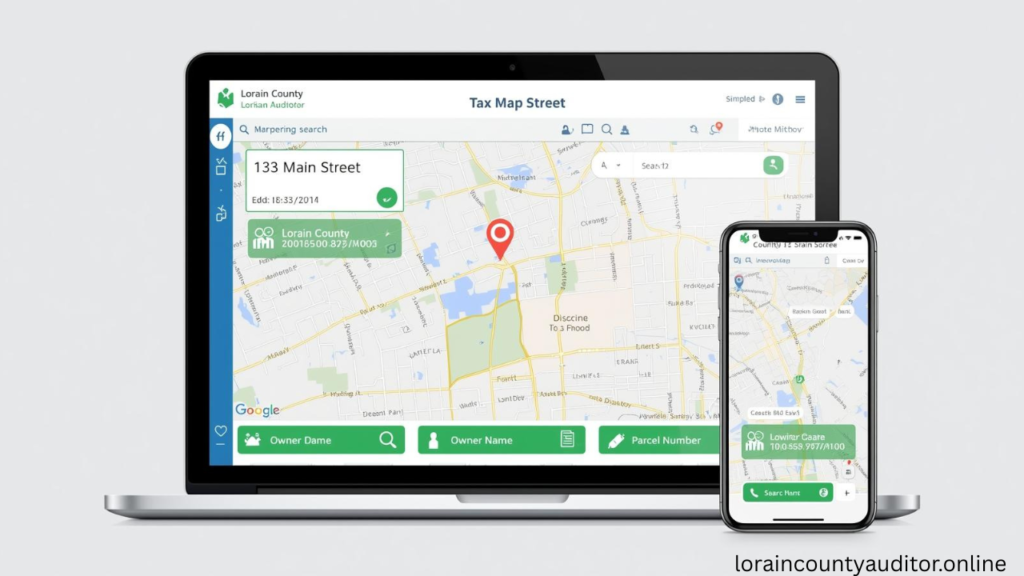
Lorain County auditor tax map online access showing digital search tools, interactive features, and mobile-responsive property lookup interface
Historical Maps and Archives
Historical editions of the Lorain County auditor map document how property boundaries, ownerships, and land divisions evolved over decades. Archives maintained by the auditor’s office or county historical societies preserve these valuable records. Comparing historical and current maps reveals subdivision activity, consolidations, and boundary changes.
Research applications for historical Lorain County auditor map collections include tracing family property ownership, understanding neighborhood development, and documenting land use changes. Local historians, genealogists, and preservation advocates use old maps to reconstruct past landscapes and settlement patterns.
Digitization efforts have made historical Lorain County auditor map collections more accessible through online portals and digital archives. Scanning old paper maps preserves deteriorating originals while enabling remote access for researchers. These digital collections support academic research, family history, and community heritage projects.
Map Accuracy and Limitations
Accuracy limitations of the Lorain County auditor map require understanding that mapped boundaries show general locations rather than survey-grade precision. The map serves administrative and reference purposes, not legal boundary determination. Property owners planning improvements near boundaries should obtain professional surveys rather than relying solely on map depictions.
Update cycles for the Lorain County auditor map mean recent property transfers, new subdivisions, or boundary adjustments might not immediately appear on maps. Processing time between recording and map updates creates temporary discrepancies. Checking recording dates helps users understand whether maps reflect the most current conditions.
Source data quality affects Lorain County auditor map accuracy, as maps derive from deeds, plats, and surveys of varying precision and age. Older properties based on metes and bounds descriptions may show less precise boundaries than modern subdivisions platted with GPS technology. Understanding source limitations prevents unrealistic expectations about map accuracy.
Verification methods for critical decisions include comparing the Lorain County auditor map to other sources like recorded plats, deed descriptions, and professional surveys. Cross-referencing multiple sources reveals discrepancies and builds confidence in property research. For legal purposes, official surveys trump map depictions.
Special Districts and Overlays
School district boundaries appear on some versions of the Lorain County auditor map, showing which educational systems serve different areas. These boundaries significantly affect property values and financial obligations. Understanding school district assignments helps families plan housing choices and researchers analyze property values.
Zoning districts sometimes overlay the Lorain County auditor map to show land use regulations affecting different areas. Residential, commercial, industrial, and agricultural zones determine permitted property uses and development intensity. While detailed zoning information requires consulting planning department records, basic district identification on maps provides useful context.
Jurisdiction boundaries visible on enhanced Lorain County auditor map versions show overlapping governmental boundaries that contribute to property bills. School districts, municipalities, townships, and special districts each claim portions of revenue. Understanding these overlaps helps property owners comprehend bill complexity.
Floodplain designations occasionally appear on the Lorain County auditor map or connected systems, identifying areas subject to periodic inundation. These environmental overlays affect development regulations, insurance requirements, and property values. Awareness of floodplain locations protects against unexpected constraints.
Conservation easements and special assessment districts that affect property taxation sometimes appear on enhanced Lorain County auditor map displays. These legal encumbrances or benefit assessments influence ownership rights and financial obligations. Identifying such conditions during property research prevents costly surprises.
Mobile Access and Field Use
Mobile-responsive versions of the Lorain County auditor map enable field access through smartphones and tablets. Property owners can verify boundaries while standing on-site, investors can research properties during neighborhood tours, and contractors can check parcel information during project planning. Mobile access extends map utility beyond office environments.
Location services on mobile devices automatically center the Lorain County auditor map on current positions, helping users identify properties without knowing addresses. This GPS integration proves particularly valuable in rural areas where street addressing may be incomplete or confusing. Real-time location awareness enhances field research efficiency.
Offline access limitations for the Lorain County auditor map mean most mobile applications require internet connectivity for full functionality. Users should download critical map sections or screenshots before traveling to areas with poor cellular coverage. Understanding connectivity requirements prevents frustration during field work.
Comparing Auditor Maps to Other Map Types
The Lorain County auditor map differs from zoning maps maintained by planning departments, though both may show property boundaries. Zoning maps emphasize land use regulations while auditor maps focus on ownership and assessment. Using both map types together provides comprehensive property understanding.
Differences between the Lorain County auditor map and recorded plats include scale, detail level, and legal status. Plats represent surveyed subdivisions with precise measurements and legal descriptions, while auditor maps compile information from multiple plats and sources at scales suitable for county-wide coverage. Both serve important but distinct purposes.
GIS mapping systems integrate the Lorain County auditor map with additional data layers showing environmental features, infrastructure, and demographic information. These enhanced systems provide analytical capabilities beyond basic map functionality. Understanding GIS capabilities helps users leverage technology for sophisticated property research.
USGS topographic maps show terrain and natural features alongside property boundaries from sources including the Lorain County auditor map. Topographic context reveals elevation changes, drainage patterns, and landscape features affecting property characteristics. Combining auditor maps with topographic information supports comprehensive site analysis.
Professional Uses and Applications
Real estate professionals rely on the Lorain County auditor map for daily property research, comparable sales analysis, and listing preparation. Agents verify property boundaries, identify adjacent parcels, and understand neighborhood layouts. The map serves as essential infrastructure supporting real estate transactions.
Title examiners reference the Lorain County auditor map during ownership research and legal description verification. Comparing mapped parcels to deed descriptions helps identify potential conflicts or errors requiring resolution. Map information contributes to clear title certification.
Surveyors use the Lorain County auditor map as preliminary reference before field surveys. The map provides context and approximate locations that guide survey planning. Professional surveys then provide precise measurements that may reveal discrepancies with map depictions.
Appraisers consult the Lorain County auditor map to verify property sizes, identify comparable sales, and understand neighborhood patterns. The visual layout helps appraisers assess location factors affecting values. Map integration with assessment data streamlines appraisal workflows.
Engineers and developers employ the Lorain County auditor map during site selection, feasibility studies, and project planning. Understanding property boundaries, ownerships, and constraints visible on maps informs development decisions. The map provides geographic framework for detailed engineering analysis.
Common Errors and How to Spot Them
Boundary discrepancies on the Lorain County auditor map sometimes occur when deed descriptions conflict with mapped depictions. Comparing legal descriptions to mapped boundaries reveals these inconsistencies. Significant differences warrant professional survey investigation before relying on either source.
Parcel number errors on the Lorain County auditor map can result in researching wrong properties or accessing incorrect records. Verifying that parcel numbers match addresses and ownership information prevents confusion. Cross-referencing multiple data elements catches number transposition or assignment errors.
Outdated ownership information connected to the Lorain County auditor map occurs when recent transfers haven’t updated in county systems. Checking deed recording dates and comparing to map update cycles reveals timing issues. For critical decisions, confirming current ownership through multiple sources ensures accuracy.
Missing subdivisions or unrecorded changes might not appear on the Lorain County auditor map if filings remain incomplete. Understanding that maps reflect only recorded information prevents assumptions about current conditions. Direct verification with recording offices confirms whether anticipated changes have processed.
Technology and Future Developments
Three-dimensional visualization enhancements may eventually show building footprints and terrain elevations on the Lorain County auditor map. These 3D features would improve understanding of property relationships and development contexts. Technology advances continue expanding what maps can display.
Augmented reality applications could overlay the Lorain County auditor map information onto real-world camera views through smartphones. Standing on a property and seeing boundaries projected onto the landscape would revolutionize field research. Such innovations may arrive as mobile technology matures.
Artificial intelligence integration might enable natural language searches of the Lorain County auditor map, where users ask conversational questions instead of learning technical search procedures. AI could identify property characteristics, suggest comparable parcels, and flag potential issues. These tools would make maps more accessible to general users.
Real-time updates to the Lorain County auditor map would eliminate lag between deed recording and map changes. As transactions process, maps would instantly reflect new ownership and boundary modifications. This synchronization would improve data currency and user confidence.
Educational Resources and Support
Tutorial videos and user guides for the Lorain County auditor map help new users navigate mapping systems and interpret displayed information. These educational materials reduce learning curves and prevent common mistakes. County auditor websites often host training resources.
Workshops and training sessions offered periodically teach community members how to use the Lorain County auditor map effectively. Real estate professionals, researchers, and interested citizens benefit from hands-on instruction. These programs build public capacity for independent property research.
Help desk support from the County Auditor’s office assists users encountering difficulties with the Lorain County auditor map. Phone, email, or in-person assistance resolves technical issues and answers questions about map interpretation. Support services ensure public access remains effective.
Privacy and Public Records
Public access to the Lorain County auditor map reflects open records laws that make property ownership information available to anyone. This transparency supports informed real estate markets and government accountability. Privacy concerns about ownership disclosure balance against public interest in accessible records.
Exemptions from public display on the Lorain County auditor map may protect certain individuals facing safety threats, though these exceptions remain limited. Understanding what information is public versus protected helps users respect legal boundaries while conducting research.
Responsible use of Lorain County auditor map data means employing information for legitimate purposes rather than harassment or discrimination. Property records serve important functions but shouldn’t be weaponized against individuals. Ethical users apply information appropriately.
Conclusion
Understanding how to access and interpret the Lorain County auditor map empowers property owners, buyers, and professionals with critical information for informed decisions. These maps represent more than administrative tools—they document property rights, financial obligations, and community organization that affect daily life. Whether verifying boundaries before construction, researching potential purchases, or appealing assessments, the auditor map provides essential data.
Responsible engagement with the Lorain County auditor map includes recognizing both its value and limitations. While maps offer official information useful for numerous purposes, they shouldn’t replace professional surveys, title examinations, or legal counsel for critical decisions. The map serves as your starting point for property research, leading to deeper investigation when situations demand precision and legal certainty.
Frequently Asked Questions (FAQs)
What is the Lorain County auditor tax map used for?
The Lorain County auditor tax map displays property boundaries, parcel numbers, and ownership patterns for assessment and public reference. It helps verify lot locations, research properties, and understand geographic relationships throughout the county.
How do I access the Lorain County auditor tax map online?
Visit the County Auditor’s website and locate the mapping or GIS section. Use search tools to find properties by address, owner name, or parcel number, or click directly on the interactive tax map.
Are property boundaries on the Lorain County auditor tax map legally accurate?
Tax map boundaries show general locations for reference, not survey-grade legal accuracy. For construction near boundaries or legal disputes, obtain a professional survey rather than relying solely on tax maps.
Can I print maps from the Lorain County auditor tax map system?
Yes, digital versions typically offer print and PDF export functions. Customize map extent and details, then generate outputs for personal use, presentations, or field reference without special permissions.
How often does the Lorain County auditor tax map update?
Update frequencies vary, with some changes appearing within weeks while others take longer to process. Recent property transfers or subdivisions may not immediately appear on tax maps due to processing time.
What is a parcel number on the Lorain County auditor tax map?
Parcel numbers are unique identifiers assigned to each property, connecting mapped land to detailed records. These numbers remain constant through ownership changes and provide stable references across county systems.
Does the Lorain County auditor tax map show easements?
Major easements may appear on tax maps, but maps don’t display all encumbrances. For complete easement information, conduct title searches or review recorded documents beyond what tax maps show.
Can I use the Lorain County auditor tax map to determine property size?
Tax maps display approximate dimensions and acreage, useful for general reference. For precise measurements needed for legal purposes, hire professional surveyors rather than relying on tax map data.
How do I report errors on the Lorain County auditor tax map?
Contact the County Auditor’s office with specific information about errors including parcel numbers and nature of inaccuracies. Staff will investigate and make corrections when warranted by documentation.
What’s the difference between the auditor tax map and zoning maps?
The Lorain County auditor tax map focuses on property boundaries and ownership for assessment, while zoning maps show land use regulations. Both may display property lines but serve different purposes.
Can I access historical versions of the Lorain County auditor tax map?
Many counties maintain historical tax map archives showing past property configurations and ownerships. Contact the auditor’s office or historical societies for access to older tax map editions.
Is there a mobile app for the Lorain County auditor tax map?
Mobile-responsive websites or dedicated apps may be available, allowing smartphone and tablet access. Check the County Auditor’s website for current mobile options and download links for tax map access